Landing Page vs Website: What Does Your Business Actually Need?
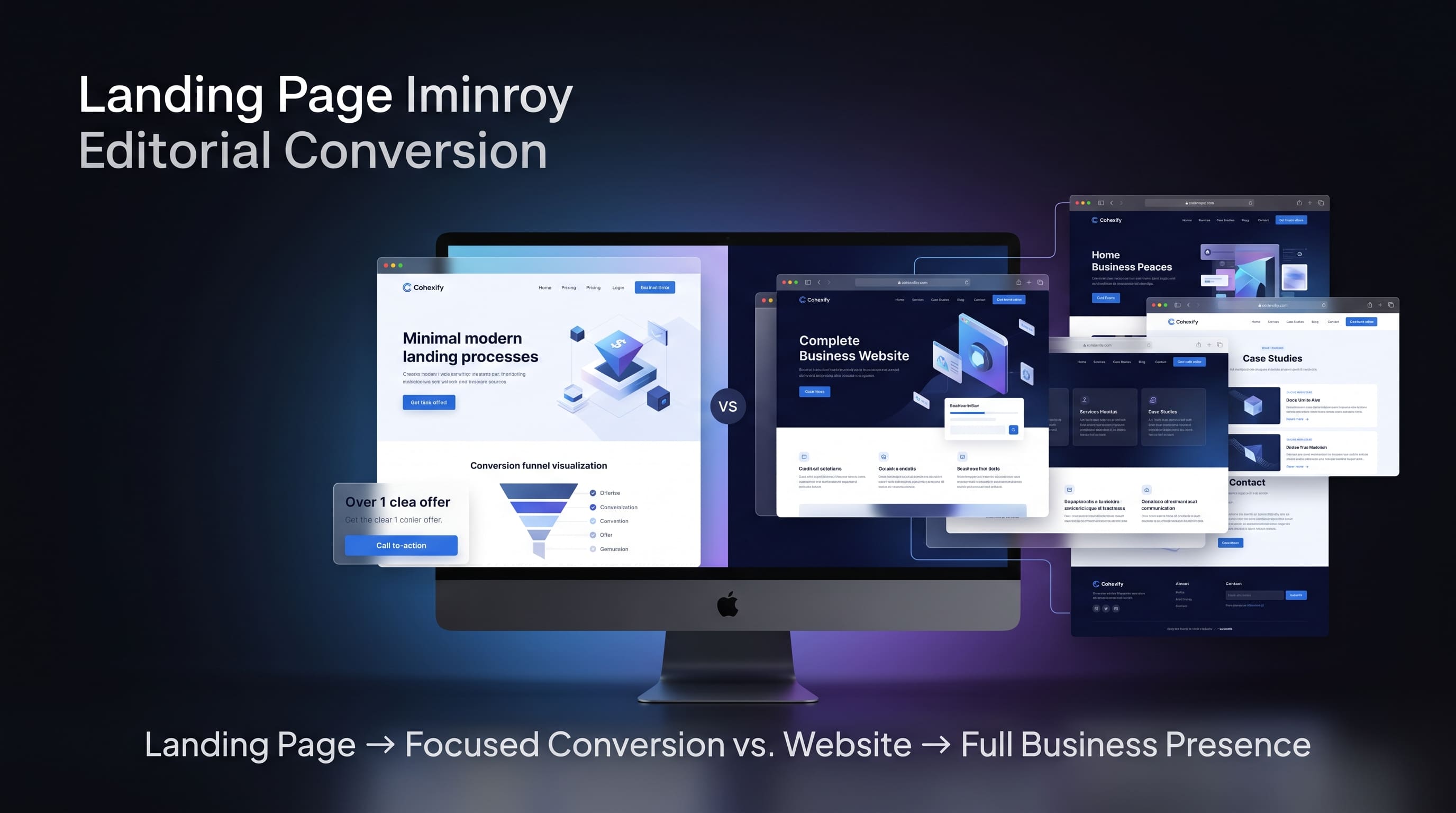
Do I need a landing page or a full website?
It sounds like a simple decision.
But choosing the wrong one can waste time and money.
A startup might spend weeks building a 15-page website when all it really needs is one page that converts visitors into demo bookings.
Another business might launch a beautiful one-page landing page when it actually needs multiple pages to establish credibility, rank on Google, explain its services, and support different customer journeys.
The right answer depends on what you're trying to achieve.
Landing Page vs Website: What's the Difference?
The simplest way to think about it is:
A landing page is built around a specific conversion goal.
A website is built around a broader business presence.
A landing page might focus on:
Get visitors to book a demo.
A website might need to:
Explain the company
Showcase multiple services
Publish content
Rank for multiple search terms
Display case studies
Answer customer questions
Build brand authority
Generate leads
Neither is automatically better.
They're designed for different jobs.
When Should You Choose a Landing Page?
A landing page is usually the better option when you have one specific offer and one primary action.
For example:
You're launching a startup
You have a new SaaS product and want to collect early signups.
You probably don't need 20 pages.
You need a focused page that explains:
Problem → Solution → Benefits → Trust → CTA
You're running paid advertising
This is one of the strongest use cases for landing pages.
Imagine you're running a Google or Meta campaign for:
"Free 15-minute business consultation."
Sending the visitor to your homepage may create unnecessary distractions.
Instead, send them to a page specifically designed around the advertisement.
Advertisement
      ↓
Specific Landing Page
      ↓
Offer
      ↓
Proof
      ↓
CTA
      ↓
Lead
The message stays consistent from the advertisement to the conversion.
You're launching a new product
A product launch often needs a focused page.
You can explain:
What the product does
Who it's for
Why it exists
Key benefits
Pricing or early-access information
Testimonials
FAQs
Call to action
Without building an enormous website.
You need something live quickly
Sometimes speed matters more than having a large website.
If you're launching a campaign next week, waiting two months for a website may cost more than building a focused landing page now.
A well-executed landing page can get you online quickly while you validate your offer.
When Should You Build a Full Website?
A full website makes more sense when your business needs multiple customer journeys.
For example, you may need:
Homepage
About page
Services
Individual service pages
Portfolio
Case studies
Blog
Contact page
Pricing
FAQs
If customers need to explore your company before contacting you, a full website becomes more valuable.
SEO is another major consideration
If your goal is to rank for many different searches, you'll generally need more than one page.
For example, a web development company might want to target:
Web development
Next.js development
SaaS development
Landing page design
Website redesign
E-commerce development
Creating dedicated pages allows each topic to have its own content, structure, internal links and search intent.
A single landing page can rank, but a structured website gives you considerably more room to build organic search visibility.
What If You're a Startup?
This is where things get interesting.
A startup doesn't necessarily need a huge website on day one.
In many cases, starting with a focused landing page can actually be smarter.
You can use it to validate:
Your positioning
Your messaging
Your offer
Your target audience
Your acquisition channels
Your conversion rate
Then expand the website once you know what customers actually respond to.
Think of it as:
Idea
 ↓
Landing Page
 ↓
Traffic
 ↓
Leads
 ↓
Customer Feedback
 ↓
Validated Offer
 ↓
Full Website
Instead of spending your entire budget building pages nobody visits.
What If You Already Have Traffic?
This changes the equation.
If you're already getting:
Google traffic
Social traffic
Paid advertising
Email traffic
Referral traffic
but you're not generating enough enquiries, you may not need more traffic.
You may need a better conversion experience.
That's where landing page optimization becomes important.
Ask:
Where are visitors dropping off?
Is your headline unclear?
Is the CTA buried?
Is the form too long?
Is there enough trust?
Does the page load quickly?
Does the mobile version work properly?
Does the offer actually match what the visitor expected?
Sometimes improving conversion is more valuable than increasing traffic.
Can a Landing Page Rank on Google?
Yes.
A landing page can rank organically if it has useful, relevant content and satisfies search intent.
But SEO should be considered from the beginning.
Important factors include:
Search intent
Page title
Headings
Content quality
Internal linking
Technical SEO
Performance
Mobile experience
Structured data where appropriate
Backlinks and authority
However, don't create a landing page purely for SEO.
Build the page for the customer first.
Then make it easy for search engines to understand.
How Much Does a Landing Page Cost Compared With a Website?
There isn't one universal price.
The cost depends on the complexity of the project.
A landing page might require:
Strategy
Copywriting
Custom UI design
Development
Forms
Analytics
SEO
CRM integration
A larger website adds more pages, content, functionality, CMS requirements and maintenance.
The better question is:
What does your business actually need to achieve its next goal?
If you're testing an offer, spending heavily on 20 pages may not make sense.
If you're an established company trying to dominate search and build authority, a single landing page probably isn't enough.
Landing Page or Website? Use This Simple Decision
Choose a landing page if:
You have one main offer
You're running paid ads
You're launching a product
You want leads quickly
You're validating a startup idea
You need a campaign page
You have one primary CTA
Choose a full website if:
You have multiple services
SEO is a major acquisition channel
Customers need extensive information
You need case studies
You publish content
You're building long-term brand authority
You have multiple audiences
You need multiple conversion paths
And sometimes you need both.
A strong business website can contain dedicated landing pages for specific campaigns and offers.
For example:
                    WEBSITE
                       ↓
       ┌───────────────┼───────────────┐
       ↓               ↓               ↓
   Services         Content        About/Brand
       ↓
   Campaign
   Landing Pages
       ↓
      Leads
That's often the strongest long-term approach.
What Should a High-Converting Landing Page Include?
At minimum, consider:
1. Clear headline
Tell visitors exactly what you offer.
2. Strong value proposition
Explain why they should care.
3. Benefits
Show what changes for the customer.
4. Social proof
Reduce uncertainty.
5. Product or service visuals
Show rather than simply tell.
6. Clear CTA
Make the next step obvious.
7. Objection handling
Answer the questions stopping someone from converting.
8. Mobile optimization
Most visitors may be on phones.
9. Performance
Don't make visitors wait for your page.
10. Analytics
You need to know what is working.
The Real Question Isn't Landing Page vs Website
The real question is:
What does your business need the website to accomplish?
If the answer is:
"We need people to book a call from our advertising campaign."
A focused landing page may be perfect.
If the answer is:
"We need to establish our brand, rank on Google, showcase 10 services, publish content and generate leads."
You probably need a proper website.
Don't build more pages simply because competitors have them.
Build what your customer journey requires.
Build for the next business milestone
At Cohexify, we focus on building digital experiences around business outcomes rather than simply adding pages.
For startups and businesses that need a focused conversion asset, we design and launch high-converting landing pages in as little as 2-3 days, including strategy, copy, UI/UX, development, mobile optimization, analytics, SEO setup and deployment.
For businesses that need a broader digital presence, we build premium portfolio and business websites designed around performance, positioning and lead generation.
The right starting point depends on your business.
Sometimes you need a website.
Sometimes you need a landing page.
And sometimes you need both.
The important thing is choosing the one that moves your business forward.